Lower Elementary

Reading, writing, and mathematical thinking.

Strong foundations.
Growing confidence.

Lower Elementary connects explicit teaching with meaningful opportunities to read, write, solve, and explore. In a multiage classroom, teachers respond to children's readiness while helping them build the foundations for increasingly independent work.

Children develop confidence through guided practice, conversation, hands-on learning, and time to apply what they know. Learning is both deliberate and connected to the world around them.
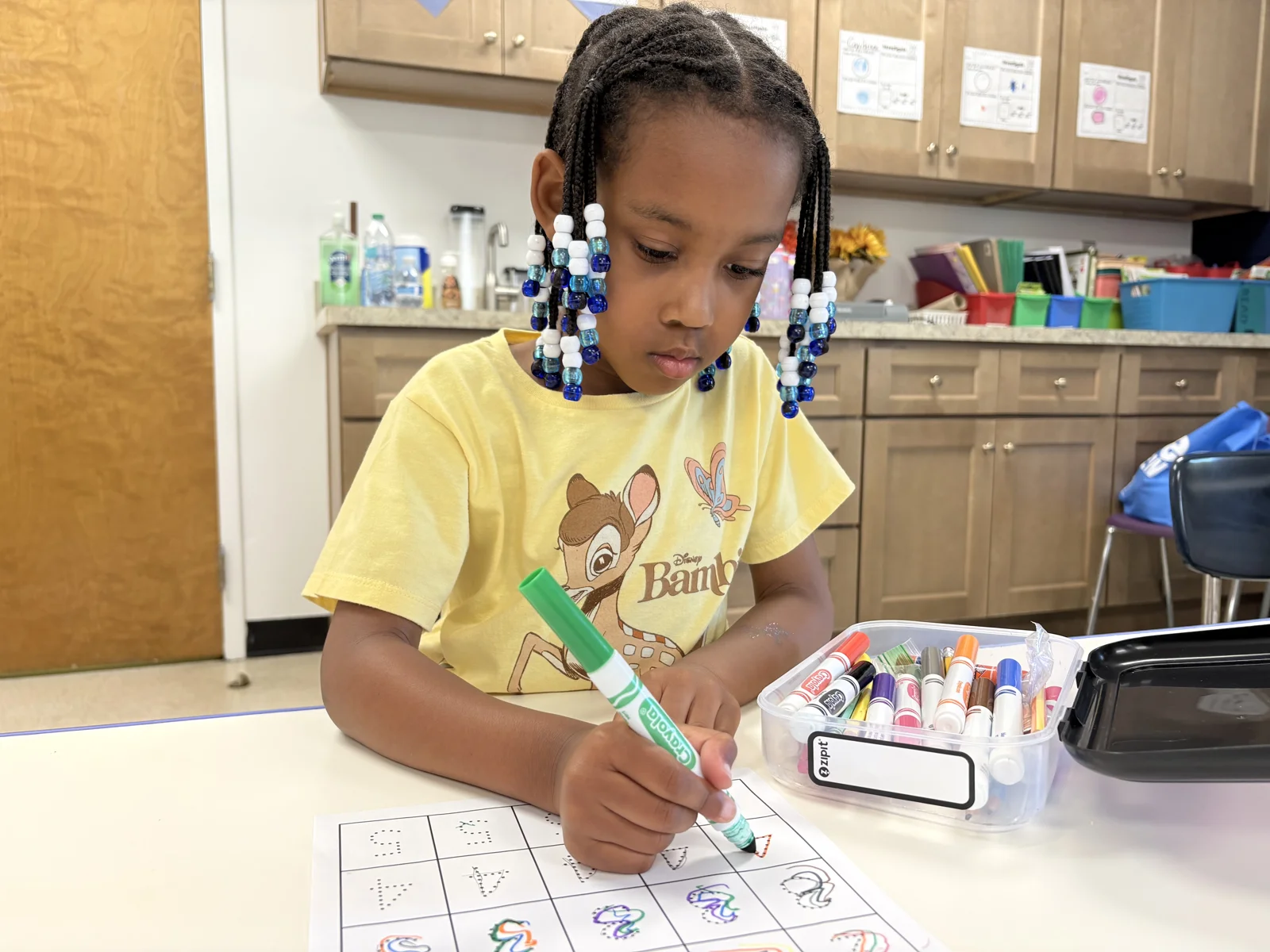
A Lower Elementary student working on a word-search activity in a Laurel classroom

Clear foundations.
Connected learning.

Explore the subjects that make up the academic day.

Reading

Explicit, systematic instruction connects sounds and letters to increasingly fluent reading. Children practice decoding, discuss stories and informational texts, build vocabulary, and develop comprehension.

Writing & Handwriting

Children learn to communicate ideas through sentences and connected writing. Instruction develops composition, mechanics, and handwriting, moving from print toward the introduction of cursive.

Spelling & Word Study

Work with sounds, spelling patterns, and words helps children connect what they hear, read, and write. Guided practice supports accurate and increasingly independent use.

Mathematics

Hands-on models, discussion, and practice build number sense, computation, fluency, and problem solving. Children learn to explain how they reached an answer.

Science & Nature Study

Investigations and outdoor observation invite children to notice, compare, ask questions, and describe what they discover about the natural world.

Social Studies & Geography

Learning connects children's lives to families, communities, maps, geography, and Virginia. Stories and inquiry broaden their understanding of people and places.

A balanced daily rhythm.

The elementary day includes focused literacy work, mathematics, science or social studies, and time for discovery. Art, music, outdoor play, and movement provide opportunities to create, collaborate, and return to academic work with fresh attention.

Predictable routines give children a secure structure, with room for meaningful questions and work that deserves more time.

Support that follows
the learner.

Teachers use observations, conversations, and student work to understand what a child can do independently and where guidance is still needed. Small-group instruction and practice allow support to respond to that evidence.

Formal progress reports at MP2, MP4, and MP6 draw on cumulative evidence. Teachers confirm growth tiers across Literacy, Mathematics, Inquiry & Knowledge, Character & Community, and Habits of Learning.

Middle States
candidacy.

The Laurel School is a candidate for accreditation through the Middle States Association of Colleges and Schools.

Accreditation is a multi-year process of self-study, peer review, and continuous improvement. Our academics, governance, and family engagement are built in alignment with Middle States standards as we move through candidacy toward full accreditation.

Begin a conversation with Laurel.

Discover how thoughtful teaching and a close-knit community can support your child.

Inquire about Laurel

Explore our other programs.